

The ladders are there - young people aren't shown how to reach them.
 June 24, 2026Posted by:
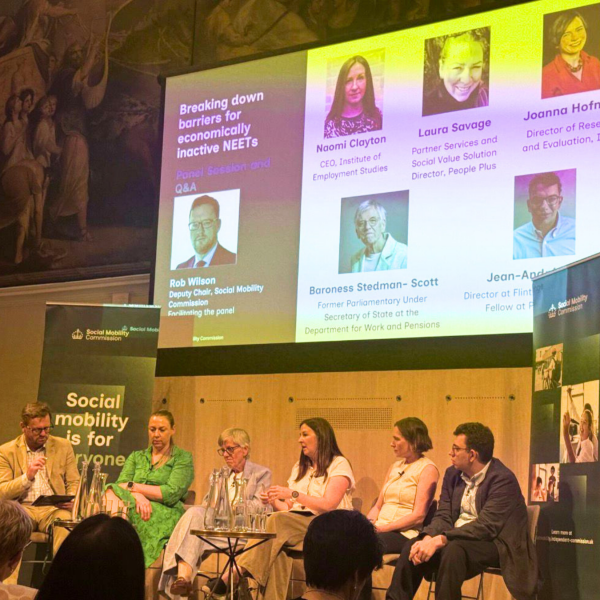
Laura Savage, Partner Services and Social Value Solutions Director at PeoplePlus, went into the Social Mobility Commission's symposium this week hoping to do her seat justice, and it was an understandable thing to hope, because the panel she joined brought together some of the most respected voices working on this: the Chief Executive of the Institute for Employment Studies, researchers from Ipsos, and a former minister at the Department for Work and Pensions, with the Commission's deputy chair, Rob Wilson, in the chair.
Laura was there representing PeoplePlus and the Social Recruitment Advocacy Group (SRAG) to talk about how to break down barriers for the roughly sixty per cent of NEET young people who are economically inactive, the ones who are neither in work nor training, and not looking for either.
A small but significant coincidence surfaced for her partway through the day. Alun Francis, who chairs the Commission, grew up in the same town as Laura and went to the same primary, junior and secondary schools. Two people who had no idea they shared a starting point now found themselves in the same national conversation about whether today's young people will get the chances they once did. For too many of them, the honest answer is that they will not.
This is not a problem that can wait. The number of young people not in education, employment or training has passed a million, the highest in over a decade, and Alan Milburn's interim review has warned of failures deep enough to cost a generation. Across the day, the room refused the version of the story that casts young people as a snowflake generation hooked on TikTok. That refusal was never clearer than when Angela Rayner reflected on her own life, a girl who left school with no qualifications and was told she would amount to nothing. The same lack of empathy that wrote her off then is being aimed at young people now, and as her life shows, talent was never the thing in short supply.
Laura shared what years of work in social recruitment and social value have taught her. Time spent alongside partners including Rise Up, Movement to Work and Youth Employment UK revealed that the gap is not a lack of provision but a failure to connect young people with what they actually need. What the day added was national weight, with senior voices underlining the same pattern: the ladders exist, but too often young people are not shown how to reach them. The symposium did not change her view that the problem is connection rather than provision. If anything, it settled it.
Charities, colleges, independent training providers, apprenticeship providers, employability and supported-employment services, health and wellbeing support, employers, philanthropists and a steady stream of new government schemes under the Youth Guarantee are all already there. The trouble is that no one holds it together for the young person standing in the middle of it. "Who connects it all," Laura asks, "and who is their mentor? Too often, no one. That is the gap."
It is the missing piece she keeps returning to. The young people who find their way through tend to have someone on their shoulder, whether a parent, a grandparent, a teacher, a sports coach or a neighbour, who can act as a sounding board and steer them when the path forks. That person is, in effect, a life mentor, and plenty of young people don't have one. Some have the opposite, a home life that actively pulls them the other way.
One story from the floor made the point better than any statistic could. A young person from a family with no history of work had started a job and set an alarm for seven thirty every morning, and the alarm woke the house. The choice put to them at home was stark: move out, or give up the job. That is the kind of barrier not listed on an eligibility form. In the snakes and ladders Laura uses to describe this work, it is a snake, one of the unseen things that sends a young person back down the board through no fault of their own. You can build all the ladders you like, but if no one is standing beside the young person, the snakes still win.
This is part of why Laura is wary of the word NEET. It is a label, and labels cut both ways. They can be a useful clue to the barriers someone faces, and they can just as easily box a person in, standing in for the harder, more human work of finding out what is actually going on. Her instinct is to put the label down and ask the simpler question: not what someone in this category usually gets, but what this particular person actually needs.
The same complexity that overwhelms young people can overwhelm employers too. Faced with thousands of schemes and providers, a stretched business may do the very human thing and freeze, wary of backing the wrong choice. Laura's image for this is hard to shake. Asking an employer to navigate all of that alone, she says, "is like asking an elephant to climb a tree", and the point is not that they won't try but that it is the wrong thing to ask of them in the first place. "Stop asking businesses to climb trees. Find a partner who can climb the tree, and work together."
That, in the end, is what Laura believes PeoplePlus is for. Several years ago she was lucky enough to hear the strategist Michael Porter speak about shared value, the idea of solving societal challenges through business, using a business model, and it has stayed with her ever since. The symposium was full of people who want the same outcome, and the fastest route to it, she argues, is not to wait for government but to bring the employers who actually do the hiring into the solution, because social value has handed every business a reason to act. Firms increasingly win or lose work on the social value they can show, so the job is to help them spend that energy well, pointing them towards the strong provision that already exists so they can build on it rather than waste time and money starting from scratch.
Laura is careful, almost insistent, about the humility of all this. She told the room plainly that PeoplePlus cannot fix it alone and does not claim to be perfect. What it can be is a constant for employers, working independently of any single funding stream, politically neutral, and a source of long-term consistency in a system that rarely sits still.
If there was one thing she felt nobody in that room could afford to forget, it was that this will not yield to tinkering. "We can't make incremental changes," she says. "We have to do something big, and substantially different, and we have to work together to decide what that is."
Laura went into the day holding the story of a young man she calls Callum, eighteen years old, bright and willing and with no idea where to start, a composite of the young people PeoplePlus and its partners meet every day. Asked what she would say to him if he had been there, she was honest, admitting that the room would have overwhelmed him, with too much choice and too much noise for him to make much sense of it. Even so, he would have left with one thing worth knowing, that there are far more people on his side than he could have realised, even if, for now, they are mostly talking to each other rather than to him.
Closing the distance between the intentions, influence and power in that room and a young person like Callum is the work. PeoplePlus, its divisions, SRAG and the wider network exist to do it with others, not alone.
If you would like to be one of the people who helps close the gap between young people and the support they need, talk to us at [email protected].
Laura Savage is Partner Services and Social Value Solutions Director at PeoplePlus, where she helps employers turn their social value commitments into practical routes into work. She represented PeoplePlus and the Social Recruitment Advocacy Group on the NEET panel at the Social Mobility Commission's 2026 symposium, chaired by Rob Wilson, Deputy Chair of the Social Mobility Commission. The session brought together Naomi Clayton, Chief Executive of the Institute for Employment Studies; Joanna Hofman, Director of Research and Evaluation at Ipsos; Baroness Stedman-Scott, former Parliamentary Under-Secretary of State at the Department for Work and Pensions; and Jean-André Prager, Senior Fellow at Policy Exchange and Director at Flint Global.
June 24, 2026Posted by: