
Social Recruitment is Business as Usual
 January 28, 2026Posted by:
From our perspective at PeoplePlus, social recruitment has been business as usual for a long time.
Over more than 30 years, our teams have engaged on the ground with people who want to work and employers who need staff, navigating the realities of access, confidence, systems and opportunity every day.
The Social Recruitment Covenant reflects that reality. It's why we created it - to bring together employers who recognise that access to work is shaped by recruitment systems, and that those systems can be designed more deliberately to improve outcomes for individuals, organisations and communities. The Social Recruitment Covenant gives structure and visibility to approaches many organisations are already using to recruit more effectively and deliver social value in practice.
Recruitment as infrastructure
Recruitment decisions determine who gets through the door, who stays, who progresses and who never gets the opportunity to show what they can do. Over time, those decisions shape workforce stability, productivity and organisational resilience.
Many recruitment systems still rely heavily on narrow indicators of employability. Linear career paths, polished CVs and confidence in interview settings continue to carry disproportionate weight, even where they are weak predictors of performance. For employers facing sustained skills shortages, those limitations are shaping recruitment outcomes, retention levels and workforce stability.
Social recruitment responds by broadening how potential is recognised within existing hiring processes. It doesn't penalise professional judgement or high standards - it improves them. It helps employers identify capability and motivation more accurately, while reducing unnecessary exclusion that ultimately weakens workforce performance and increases risk.
From specialist practice to shared approach
One of the clearest changes we’ve seen is how social recruitment is now embedded within mainstream recruitment practice. Organisations are no longer treating it as separate from “core” recruitment activity. Instead, it is increasingly part of workforce planning, retention strategies and wider social value delivery. Talent and social value specialists are taking their place at the table.
The employers committing to the Social Recruitment Covenant both drive and reflect this shift. They speak in practical terms about how they find talent, how it shows up, about reflecting the communities they serve, and about learning as they go. These are operational considerations that sit alongside productivity, service delivery and long-term workforce planning.
The Social Recruitment Covenant provides a way to formalise that thinking, while allowing organisations to start from different points and progress at different speeds. It recognises that social recruitment is applied through systems, policies and everyday decisions, rather than standalone initiatives.
The role of the SRAG and the Social Recruitment Framework
The Social Recruitment Covenant sits alongside the work of the Social Recruitment Advocacy Group, and our Social Recruitment Services team, who bring employers and partners together to share learning, build confidence and test approaches to inclusive recruitment in real-world settings - with significant success. One SRAG member recently reported that 50% of their placements were coming from social recruitment pathways - and their goal for 2026 is 65%.
For some organisations, signing the Social Recruitment Covenant is an entry point. For others, it reflects practice already embedded within recruitment and social value governance structures. In both cases, the value lies in connection. Employers benefit from seeing how peers across sectors are responding to similar pressures, and from engaging with social recruitment as a shared challenge rather than an isolated one.
From a PeoplePlus perspective, that collective learning is what sustains social recruitment as business as usual over time.
Where this leads
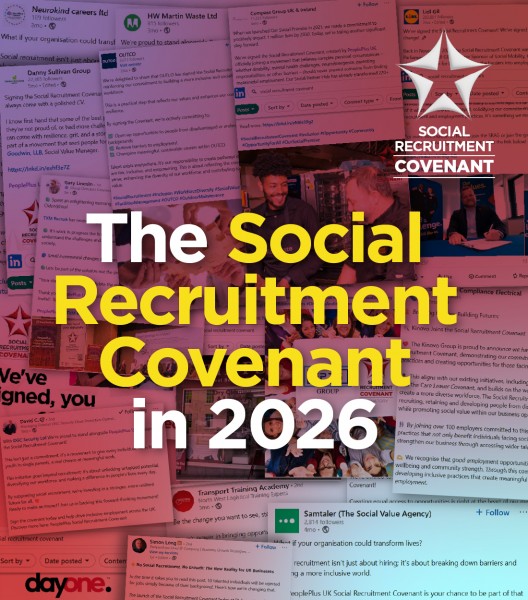
We've published a companion article bringing together a selection of thoughts on what employers are saying about the Social Recruitment Covenant, exploring how social recruitment is being embedded into recruitment systems, social value frameworks, governance and impact measurement in practice.
The Social Recruitment Covenant provides a shared reference point for organisations navigating these challenges. Endorsed by the Department for Work and Pensions, it connects employer experience with practical delivery, governance and impact measurement.
Signing the Social Recruitment Covenant doesn’t signal completion or demand perfection. It signals commitment, realism and a willingness to engage.
If you recognise your organisation in any of the reflections above, it may be time to consider the role you play in shaping access to work in 2026, and how visible you choose to be about that. This is a practical, proportionate commitment that organisations of all sizes and sectors can engage with, in ways that reflect how they already employ people - and their ambition for the future.
[email protected]
January 28, 2026Posted by: